Parents often ask me what the difference is between an articulation disorder and a phonological disorder. Here is the difference:
Articulation Disorder:
Articulation is the process by which sounds, syllables, and words are formed when your tongue, jaw, teeth, lips, and palate alter the air stream coming from the vocal folds. When an individual cannot produce or distorts an age-expected sound, it affects the ability of the person to be understood. With an articulation disorder, the child has difficulty saying certain sounds or consonants- for example “wake” for “rake” or as seen with a lisp. Articulation disorders are motor errors than can occur among people of any age; however, they are most common in children whose articulators have not fully developed properly.
Phonological Process Disorder:
A phonological disorder is a simplification of the sound system that also affects intelligibility. Children with phonological processes have difficulty in acquiring a phonological system; involving organizing the patterns of sounds in the brained the output.; not necessarily in the motor production of the sounds like articulation errors. For example, “fronting” is when sounds that should be produced by the tongue moving up in the back of the throat are replaced with front sounds -“cake” becomes “take” or “gold” becomes “dold”. This is typically seen in children whose speech would be considered unintelligible, but can also be seen in children through kindergarten that are developing normally. Other examples of phonological processes include initial and final consonant deletion, cluster reduction, stopping, backing, gliding, syllable reduction, and consonant harmony.
Both articulation and phonological disorders put a child at risk for difficulties in school, both academically, as well as socially. If you feel that your child may have a speech disorder, be sure to have his/her speech evaluated by a licensed speech-language pathologist.
Motor Speech Disorders
What are motor speech disorders?
A motor speech disorder is present when a child or adult struggles to produce speech because of problems with motor planning or muscle tone needed to speak. There are two major types of motor speech disorders: dysarthria and apraxia.
What is dysarthria?
Dysarthria, often called slurred speech, is defined as slow, imprecise, and distorted speech that is the result of weakness, paralysis, spasticity, or the inability to control or coordinate the muscle used during speech. Common causes of dysarthria in children include traumatic brain injuries, stroke, brain tumor, and degenerative brain disorders.
What is apraxia?
Apraxia is a communication disorder affecting the motor programming system for speech production. Speech production is difficult – specifically with sequencing and forming sounds. The person may know what he wants to say, but there is a disruption in the part of the brain that sends the signal to the muscle for the movement necessary to produce the sound. That leads to problems with articulation as well as intonation and speaking stress and rhythm errors. Apraxia of Speech can be discovered in childhood (CAS), or might be acquired (AOS) resulting from a brain injury or illness in both children and adults.
What are the symptoms of a motor speech disorder?
A child with a motor speech disorder may appear to want to form words but is unable to do so. They may demonstrate speech that is slurred or difficult to understand. A child with a motor speech disorder may be able to form one word clearly, but speech will become difficult to understand as statements get longer.
How are motor speech disorders diagnosed?
A comprehensive speech and language evaluation is necessary to diagnose if a motor speech disorder is contributing to a child’s communication impairment. Children with complex neurological conditions may have a motor speech disorder with other communication impairments.
How are motor speech disorders treated?
Specific treatment for motor speech disorders will be determined by the child’s speech and language therapist and other members of the child’s medical team based on:
- The child’s age, overall health and medical history.
- Extent of the disorder.
- Type of disorder.
- Expectations for the course of the disorder.
- The family’s opinion or preference.
Specific motor speech therapy techniques may include exercises to improve a child’s breath support for speech, oral motor exercises and repetition of sounds and syllables with increasing levels of difficulty. Play-based therapy techniques and reinforcement are used to make therapy fun and motivating for children.
Stuttering
What is stuttering?
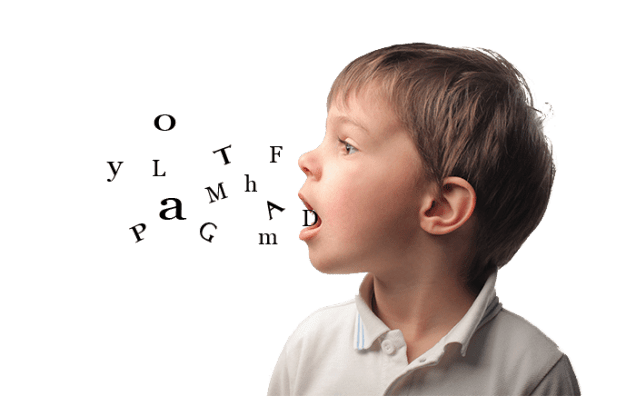
Stuttering affects the fluency of speech. It begins in childhood, and in some cases lasts throughout life. The disorder is characterized by disruption in the production of speech sounds, also called dysfluencies.
Some examples of stuttering include:
- “W- W- W- Where are you going?” (Part-word repetition: The person is having difficulty moving from the “w” in “where” to the remaining sounds in the word. On the fourth attempt, he successfully completes the word.)
- “SSSS ave me a seat.” (Sound prolongation: The person is having difficulty moving from the “s” in “save” to the remaining sounds in the word. He continues to say the “s” sound until he is able to complete the word.)
- “I’ll meet you – um um you know like – around six o’clock.” (A series of interjections: The person expects to have difficulty smoothly joining the word “you” with the word “around.” In response to the anticipated difficulty, he produces several interjections until he is able to say the word “around” smoothly.)
How is stuttering diagnosed?
Identifying stuttering in an individual’s speech would seem like an easy task. Disfluencies often “stand out” and disrupt a person’s communication. Listeners can usually detect when a person is stuttering. At the same time, however, stuttering can affect more than just a person’s observable speech. Some characteristics of stuttered speech are not as easy for listeners to detect. As a result, diagnosing stuttering requires the skills of a certified speech-language pathologist (SLP).
During an evaluation, an SLP will note the number and types of speech disfluencies a person produces in various situations. The SLP will also assess the ways in which the person reacts to and copes with disfluencies. The SLP may also gather information about factors such as teasing that may make the problem worse. A variety of other assessments (e.g., speech rate, language skills) may be completed as well, depending upon the person’s age and history. Information about the person is then analyzed to determine whether a fluency disorder exists. If so, the extent to which it affects the ability to perform and participate in daily activities is determined.
For young children, it is important to predict whether the stuttering is likely to continue. An evaluation consists of a series of tests, observations, and interviews designed to estimate the child’s risk for continuing to stutter. Although there is some disagreement among SLPs about which risk factors are most important to consider, factors that are noted by many specialists include the following:
- a family history of stuttering
- stuttering that has continued for 6 months or longer
- presence of other speech or language disorders
- strong fears or concerns about stuttering on the part of the child or the family
No single factor can be used to predict whether a child will continue to stutter. The combination of these factors can help SLPs determine whether treatment is indicated.
For older children and adults, the question of whether stuttering is likely to continue is somewhat less important, because the stuttering has continued at least long enough for it to become a problem in the person’s daily life. For these individuals, an evaluation consists of tests, observations, and interviews that are designed to assess the overall severity of the disorder. In addition, the impact the disorder has on the person’s ability to communicate and participate appropriately in daily activities is evaluated. Information from the evaluation is then used to develop a specific treatment program, one that is designed to:
- help the individual speak more fluently
- communicate more effectively
- participate more fully in life activities
What treatments are available for stuttering?
Most treatment programs for people who stutter are “behavioral.” They are designed to teach the person specific skills or behaviors that lead to improved oral communication. For instance, many SLPs teach people who stutter to control and/or monitor the rate at which they speak. In addition, people may learn to start saying words in a slightly slower and less physically tense manner. They may also learn to control or monitor their breathing. When learning to control speech rate, people often begin by practicing smooth, fluent speech at rates that are much slower than typical speech, using short phrases and sentences. Over time, people learn to produce smooth speech at faster rates, in longer sentences, and in more challenging situations until speech sounds both fluent and natural. “Follow-up” or “maintenance” sessions are often necessary after completion of formal intervention to prevent relapse.
What can I do to communicate better with people who stutter?
Often, people are unsure about how to respond when talking to people who stutter. This uncertainty can cause listeners to do things like look away during moments of stuttering, interrupt the person, fill in words, or simply not talk to people who stutter. None of these reactions is particularly helpful, though. In general, people who stutter want to be treated just like anybody else. They are very aware that their speech is different and that it takes them longer to say things. Unfortunately, though, this sometimes leads the person to feel pressure to speak quickly. Under such conditions, people who stutter often have even more difficultly saying what they want to say in a smooth, timely manner. Therefore, listeners who appear impatient or annoyed may actually make it harder for people who stutter to speak.
When talking with people who stutter, the best thing to do is give them the time they need to say what they want to say. Try not to finish sentences or fill in words for them. Doing so only increases the person’s sense of time pressure. Also, suggestions like “slow down,” “relax,” or “take a deep breath” can make the person feel even more uncomfortable because these comments suggest that stuttering should be simple to overcome, but it’s not!
Of course, different people who stutter will have different ways of handling their speaking difficulties. Some will be comfortable talking about it with you, while others will not. In general, however, it can be quite helpful to simply ask the person what would be the most helpful way to respond to his or her stuttering. You might say something like, “I noticed that you stutter. Can you tell me how you prefer for people to respond when you stutter?” Often, people will appreciate your interest. You certainly don’t want to talk down to them or treat them differently just because they stutter. However, you can still try to find a matter-of-fact, supportive way to let them know that you are interested in what they are saying, rather than how they’re saying it. This can go a long way toward reducing awkwardness, uncertainty, or tension in the situation and make it easier for both parties to communicate effectively.
 Palm Beach Speech Teach